
Xsens x Project MARCH
At Project MARCH, we work in a fast-paced R&D environment where we are constantly iterating and improving our exoskeleton over a limited amount of time. We often uncover sneaky problems that we didn’t expect, requiring us to think of creative solutions in a short time. One such case was during our testing phase this past month when we discovered that the exoskeleton’s frame, originally made almost entirely out of aluminium, could deform such that our joints couldn’t reach the desired positions. This deformation was logical and not detrimental to the health and durability of the frame, but it was a critical problem to ensure the exoskeleton executes controls as expected. We decided to re-make some parts out of steel to minimize the deformations as it is a stronger metal, but this was not going to solve the problem completely: we needed software to correct for the remaining deformation. Correcting for the deformation is crucial for closing the sim-to-real gap, which we need in order to get closer to our main goal this year: walking without crutches.
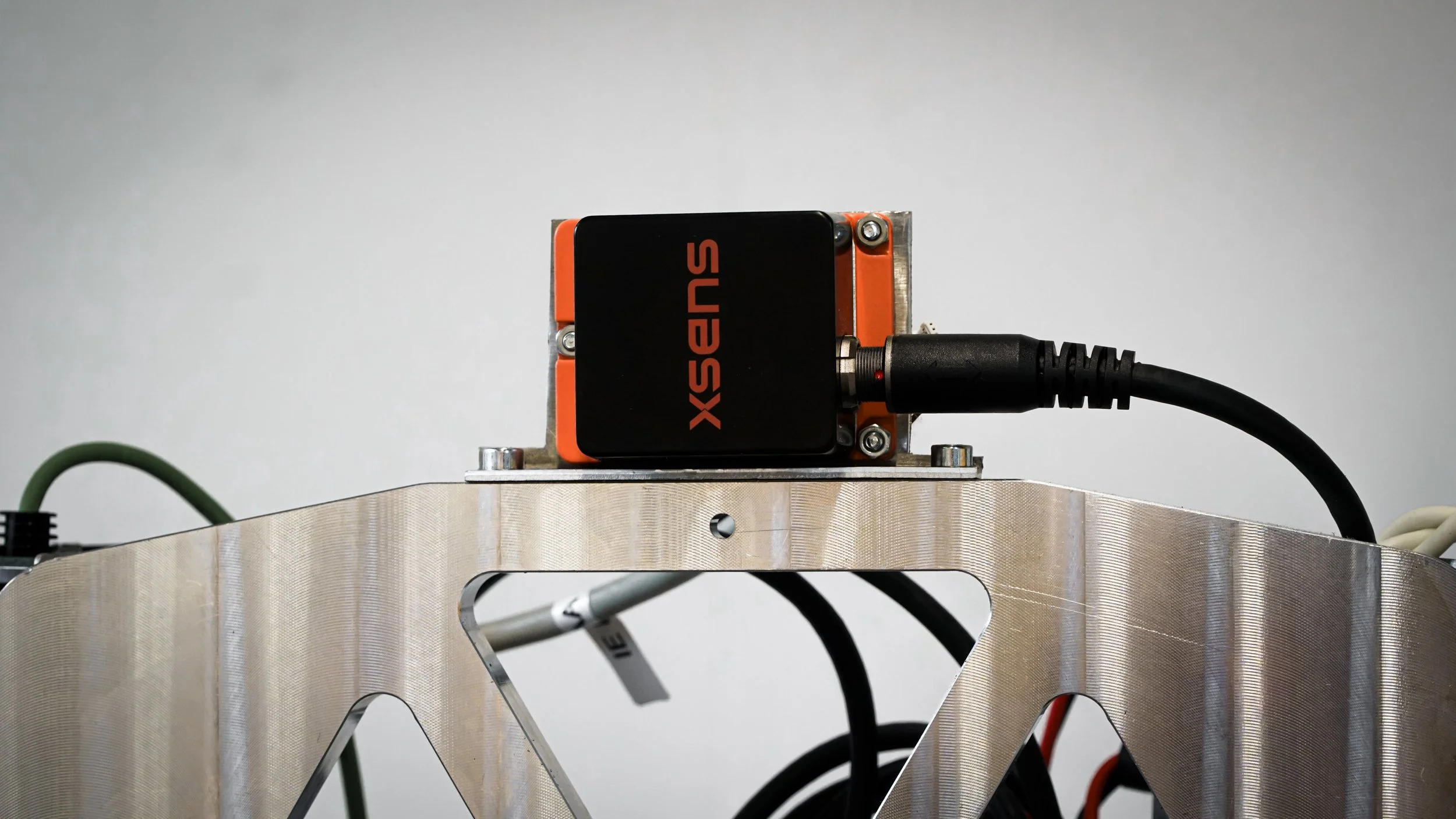
The Xsens MTi-630R IMU placed in the exoskeleton’s backpack (shown here without the covers or fixtures).
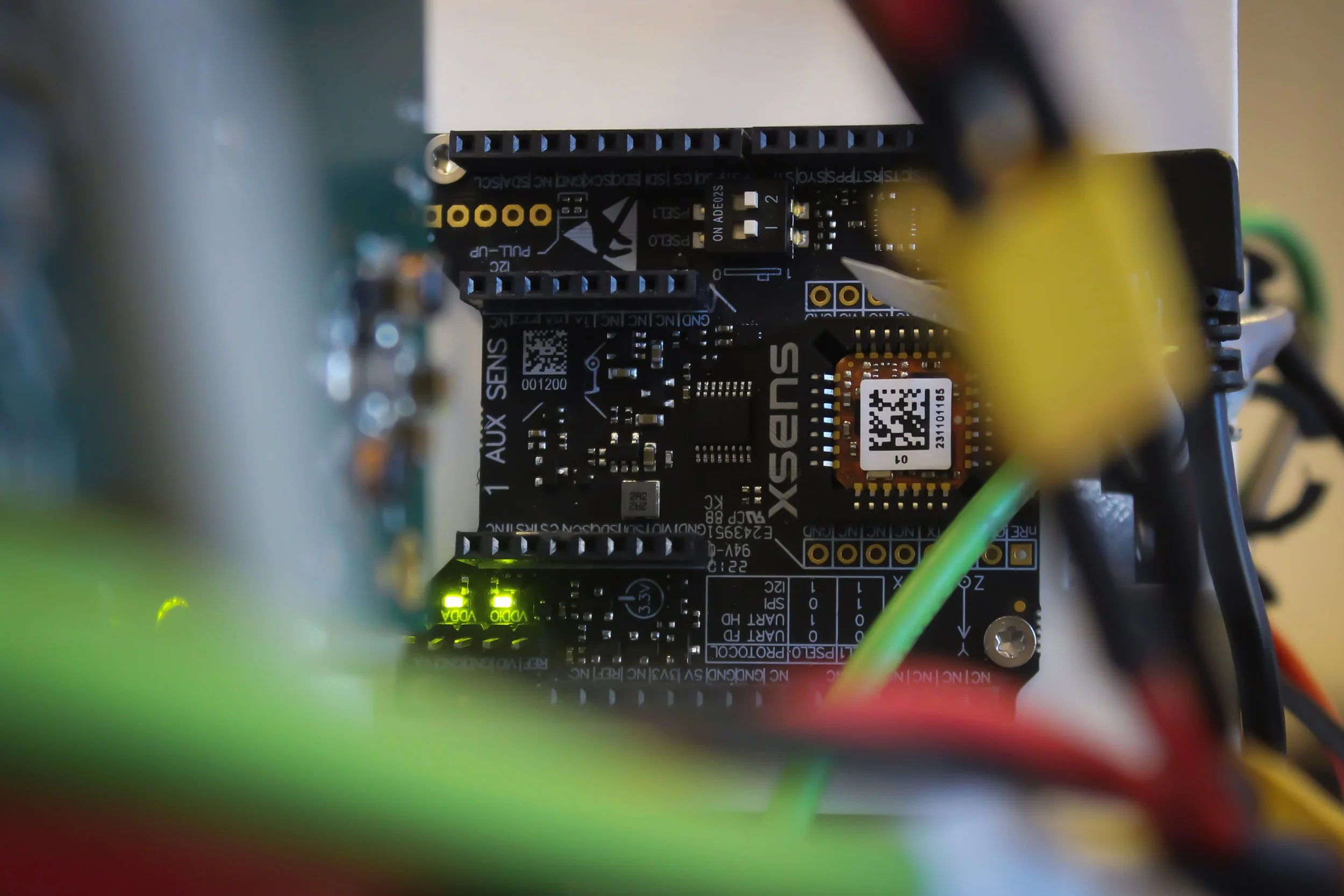
One of the two Xsens MTi-3 IMUs placed under the rotational hip joint.
Instead of changing our simulation to model our hardware more accurately, we went the other way by adding sensors to more accurately measure our hardware’s position giving us the possibility to ensure our hardware is more accurate to our simulation. Our software engineers did this by adding an extra control loop using 3 Xsens Inertial Measurement Units (IMUs) in the backpack and upper legs. Using the Xsens MTi-630R IMU placed in the exoskeleton’s backpack and two smaller Xsens MTi-3 IMUs in the upper legs, we can compare their real position and orientation in space, compare this to what they should be according to our simulation which assumes no deformation of the frame, and tell our motors to give a little extra tug or push to get the exoskeleton to the exact position we want it to be.
With this last-minute addition, we are many steps closer to a completely self-balanced exoskeleton. Big thank you to Xsens for providing these sensors and expertise, and to our team for being so flexible with the quick changes that needed to happen across departments!